For crafters and small businesses focusing on custom caps, a reliable hat press is essential. This guide highlights five top-performing hat press machines designed for heat transfer applications, including sublimation, DTF film, embroidery patches, and vinyl transfers. Each pick balances speed, consistent pressure, and user-friendly controls to deliver professional results on a variety of cap styles. Read on for feature highlights, an image glance, and practical buying considerations to help you choose the right model for your project load and budget.
| Product | Brand | Key Feature |
|---|---|---|
| HTVRONT Hat Press Machine (Two Platens) | HTVRONT | Cast aluminum heating plate, dual platens, memory mode |
| VEVOR 4-in-1 Hat Press | VEVOR | Four interchangeable platens, large heating plate, digital control |
| EENOUR Hat Press Machine | EENOUR | Two platens, three heat levels, safety base |
| HTVRONT Auto Hat Press Machine | HTVRONT | One-touch automatic operation, high pressure, dual platens |
| OLIXIS Hat Press Machine | OLIXIS | Wide temp range, memory presets, curved platen |
The following sections spotlight each model with key specifications, practical notes, and real-world suitability. All selections are focused on heat transfer for caps and related apparel, with an eye toward consistency, ease of use, and versatility across cap shapes and materials.
HTVRONT Hat Press Machine, 2 Platens

The HTVRONT hat press features a one-piece cast aluminum heating plate that promotes even heat distribution and longer life versus silicone plates. A four-bar linkage improves leverage for smoother operation, while a high-visibility digital display shows real-time temperature and countdown. The machine ships with two platens sized for most caps (6.5 x 3.3 inches and 6.5 x 2.5 inches) and includes a cap stretcher to help minimize wrinkles on irregular shapes.
Ideal for studios that handle a variety of cap shapes and transfers, this model emphasizes reliability and repeatable results. The memory mode helps maintain preset temperatures for common workflows, reducing setup time between designs. The dual platen configuration broadens capability for different cap styles, including fitted or structured caps. For users prioritizing quick startup and consistent presses, this HTVRONT option can be a strong baseline choice.
VEVOR 4-in-1 Hat Press
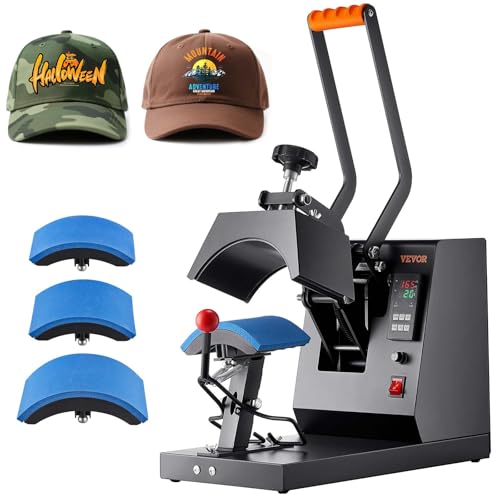
This four-in-one hat press combines four heat pads in one machine, offering 6 x 3, 6.7 x 2.7, 6.7 x 3.8, and 8.1 x 3.5 inch options. An 8.5 x 4 inch heating plate provides a generous working surface, enhancing compatibility with a wide range of cap shapes, including berets, baseball caps, and bucket hats. The aluminum, Teflon-coated plate minimizes sticking and simplifies cleaning. A smart digital control panel simultaneously displays temperature and time, supporting precise, repeatable transfers from 104 to 410°F (40–210°C).
Suitable for crafters who want a single machine capable of handling multiple cap forms without swapping equipment. The large plate and replaceable elements support more complex or larger designs, though setup and learning curves may be steeper for newcomers. Overall, it’s a versatile choice for makers who plan to offer varied, custom headwear products.
EENOUR Hat Press Machine, 2 Plats

The EENOUR model emphasizes heat uniformity with a 5.5 x 3 inch arched heating plate and a 3.15 x 5.5 inch curved platen to accommodate most cap shapes. An insulated safety base adds an extra layer of user protection. The machine supports three heating levels (low, medium, high) to tackle different materials and transfer types. This option is well-suited for hobbyists and small shops looking for controlled, repeatable results without overinvesting in specialized equipment.
Practical notes include ensuring adequate hat-to-plate contact to maximize heat transfer and avoiding gaps that could lead to uneven results. The multiple heat settings provide flexibility for vinyl, sublimation, and patch transfers, making it a solid all-around entry for beginners expanding into cap customization.
HTVRONT Auto Hat Press Machine

This model brings one-touch automation to hat pressing, reducing manual lifting and lowering for consistent pressure and timing. It’s designed for small businesses, studios, and DIY crafters who want to streamline workflows. The press delivers substantial clamping force (over 80 kg) to handle DTF film, embroidery patches, rhinestones, and sublimation materials with reliable results. Two interchangeable platens support varying hat sizes, making it practical for teams producing multiple cap styles.
As with automated systems, consider whether your production pace justifies the higher upfront cost and whether your typical designs fit within the supported platens. The automation feature is a clear time-saver for high-volume runs and reduces operator variance across shifts.
OLIXIS Hat Press Machine
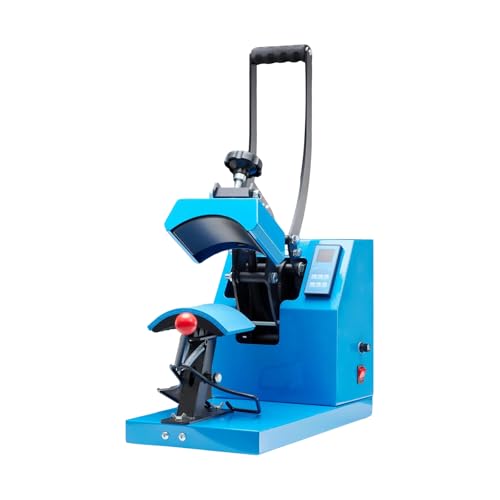
The OLIXIS hat press stands out with a broad temperature range (32–570°F) and memory presets to save common recipes, speeding up repetitive projects. A curved 3.2 x 5.5 inch platen suits many cap shapes, while a 0–999 second timer provides precise press cycles. Memory Mode helps streamline workflows for recurring designs, benefiting shops that run multiple batches of the same cap artwork.
This model balances flexibility and control, making it a reliable option for both beginners and pros who need dependable results across different materials, such as vinyl, patches, and sublimation. The user experience hinges on effectively leveraging memory presets to maintain consistency from batch to batch.
Buying Guide: Key Purchase Considerations
- Cap compatibility: Check platen sizes and curvature to ensure coverage for your target hats (adjustable vs. fixed platens, arched vs. flat designs).
- Temperature and time control: A wide range and precise digital readouts help accommodate different materials (vinyl, sublimation, DTF, patches).
- Pressure consistency: Uniform, stable pressure across the hat surface is essential for wrinkle-free transfers; consider models with robust gripping or automation to reduce operator variance.
- Ease of use: Look for features like memory presets, auto-off or auto lift, and intuitive interfaces that align with your workflow and staffing.
- Durability and maintenance: Cast aluminum plates tend to distribute heat evenly and last longer than silicone alternatives; consider cleaning and anti-stick coatings (e.g., Teflon).
- Throughput and scalability: If you plan high-volume production, automated or multi-platen options save time but require higher investment.
- Support and warranty: Evaluate vendor reliability, customer service responsiveness, and warranty terms for ongoing protection.
Multiple Perspectives On Cap Pressing
For hobbyists, a compact, easy-to-use press with clear temperature readouts and basic safety features often suffices. Beginners may favor models with memory modes and guided workflows to minimize trial-and-error. For small businesses, automation, dual platens, and robust pressure are more critical to maintain consistent results across batches. Professionals handling diverse cap materials may prioritize interchangeable platens, wider temperature ranges, and quick-platen swaps that reduce downtime between designs. Always align the chosen model with your typical cap shapes, transfer types, and expected production tempo.