Choosing the right carbon fiber reinforced filament can dramatically improve the strength, stiffness, and dimensional stability of 3D printed parts. This guide highlights top inland carbon fiber filaments from reputable brands, comparing performance, print settings, and practical applications. Each entry includes key features to help you select materials for durable, high-precision parts such as drone components, mechanical hinges, and lightweight tooling. Use the buying guide to balance print speed, toughness, and surface finish across different printers and projects.
| Brand | Product | Diameter / Spool | Notable Benefit |
|---|---|---|---|
| ELEGOO | PLA-CF Filament | 1.75 mm / 1 kg | Excellent strength and smooth surface |
| Creality | PLA Carbon Fiber Filament | 1.75 mm / 1 kg | Very high-speed printing potential |
| OVERTURE | PLA Carbon Fiber Filament | 1.75 mm / 1 kg | High dimensional accuracy |
| FLASHFORGE | Carbon Fiber PETG Filament | 1.75 mm / 1 kg | Great balance of strength and heat resistance |
| Creality | Carbon Fiber Filament | 1.75 mm / 1 kg | Low warp with strong performance |
| INLAND | PLA Filament | 1.75 mm / 1 kg | Improved toughness and easy printing |
ELEGOO Carbon Fiber PLA Filament 1.75mm Black

ELEGOO PLA-CF combines carbon fiber reinforcement with standard PLA to deliver improved strength and stiffness suitable for durable, impact-resistant parts. The filament emphasizes better layer adhesion, resulting in smoother surfaces with less visible layer lines—a key advantage for complex designs and high-quality prints. With a diameter of 1.75 mm and dimensional accuracy of +/- 0.02 mm, it feeds consistently and minimizes tangling on neatly wound spools. This makes it a reliable choice for hobbyists and professionals needing precise, repeatable results.
Creality Carbon Fiber Filament 1.75mm PLA Carbon Fiber

Creality’s PLA Carbon Fiber filament targets both high-speed and high-detail printing. Designed to print at speeds up to 300 mm/s without sacrificing quality, it balances strength, adhesion, and pace for rapid prototyping. The carbon fiber reinforcement yields up to 30% higher mechanical properties than standard PLA in flexural strength, modulus, and impact resistance. It’s ideal for structural parts and joints that demand lighter weights without compromising rigidity, making it suitable for model drones, machinery components, and other demanding projects.
OVERTURE PLA Carbon Fiber Filament 1.75mm
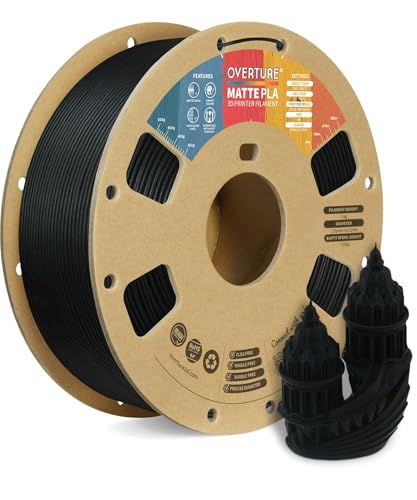
OVERTURE’s carbon fiber PLA emphasizes dimensional accuracy with a robust 1.75 mm diameter tolerance of +/- 0.02 mm. The filament is fully wound and subject to strict quality checks to minimize tangles and feeding issues, ensuring smooth extrusion. The combination of carbon fiber and PLA is well-suited for hobbyist and professional applications requiring stiff, lightweight parts with reliable print quality. It supports standard 3D printers with typical PLA temperatures, easing setup for operators upgrading to carbon-reinforced materials.
FLASHFORGE Carbon Fiber PETG Filament 1.75mm

FLASHFORGE PETG-CF blends carbon fiber with PETG to deliver enhanced strength and rigidity while maintaining impact resistance. It offers superior heat resistance compared to standard PETG, making it suitable for components exposed to higher temperatures in automotive, electronics, or machinery contexts. Wear resistance is improved as well, useful for gears, bearings, and sliding components. The filament is designed to minimize moisture uptake and printing defects, supporting reliable namesake prints with good surface finish and durability.
Creality Carbon Fiber Filament 1.75mm

Creality’s carbon fiber filament for 3D printers emphasizes low warp and strong performance, offering improved strength and dimensional stability. The filament is designed to deliver uniform lines and a clean final appearance, ideal for artistic pieces and mechanical components alike. The material combines carbon reinforcement with eco-conscious chemistry, featuring weather and chemical resistance and reduced odor emission. It’s a practical option for users needing dependable prints with minimal post-processing on K1C, K1 Max, and compatible printers.
Inland PLA Filament 1.75mm Black

Inland’s PLA filament is produced from Ingeo pellets manufactured in Nebraska and is designed for smooth extrusion and reliable, consistent prints. The coal-black color and upgraded formula emphasize toughness and durability while maintaining the easy-print nature of standard PLA. Typical extrusion temperatures range from 190°C to 230°C, with bed temperatures between 45°C and 60°C. Inland PLA aims to provide strong layer bonding, reduced brittleness, and dependable results for everyday prints, prototyping, and educational projects.
FLASHFORGE Carbon Fiber PETG Filament 1.75mm

FLASHFORGE PETG-CF combines carbon fiber reinforcement with PETG, delivering substantial strength and temperature resistance while preserving impact resistance. The filament is manufactured with clog-free and bubble-free processes to ensure consistent extrusion. It is pre-dried for moisture control and vacuum-sealed with desiccant to maintain print quality. This makes it a strong candidate for parts requiring dimensional stability and resistance to wear and deformation in varied environments.
FLASHFORGE Carbon Fiber PLA Filament 1.75mm

FLASHFORGE PLA-CF features a high carbon fiber content to markedly improve strength and rigidity, making printed parts more resistant to deformation under load. The filament remains lightweight, supporting applications in aerospace, automotive, and other sectors where weight is a factor. Wear resistance is improved too, benefiting gears, bearings, and moving joints. The result is a versatile material suitable for durable, lightweight prototypes and end-use parts that demand reliable performance.
Buying Guide: Key Purchase Considerations And Comparisons
- Filament Type And Compatibility: Carbon fiber filaments typically come as PLA, PETG, or blends. PLA-CF prints at lower temperatures and is easiest to handle, while PETG-CF offers higher heat resistance and toughness. Consider your printer’s hot-end capabilities and bed adhesion when selecting a filament type.
- Diameter Tolerance And Winding: Look for precise diameters (±0.02–0.03 mm) and tightly wound spools to minimize feeding issues and tension-related print defects. Consistent diameter improves extrusion stability, especially at higher speeds.
- Strength, Stiffness, And Weight: Carbon fiber reinforcement increases stiffness and strength while reducing weight. For functional parts like brackets, housings, or drone components, prioritize materials with high flexural strength and low warping.
- Print Speed And Layer Adhesion: Some carbon fiber filaments enable faster printing without sacrificing quality. Filaments with improved layer adhesion reduce delamination and improve dimensional accuracy for complex geometries.
- Moisture Sensitivity: Many carbon fiber filaments are sensitive to moisture, which can cause bubbling or poor surface finish. Dry storage or vacuum-sealed packaging with desiccants helps maintain performance.
- Post-Processing And Finish: Carbon fiber streaks and rougher surfaces may require light sanding or coating. Some filaments yield smoother finishes, while others emphasize strength over cosmetic appearance.
- Printer And Nozzle Considerations: CF filaments can be abrasive; using hardened steel nozzles can extend nozzle life. If your printer’s build area or enclosure affects print quality, factor in cooling and airflow.
In summary, inland carbon fiber filaments offer a spectrum of performance—ranging from easy-to-print PLA-CF options to tougher PETG-CF alternatives. When selecting a filament, align your project needs with the material’s balance of strength, heat resistance, and print ease. Always verify your printer’s temperature range, nozzle material, and bed adhesion strategy before starting a CF print to maximize reliability and part quality.