Choosing the right iron-on embroidery transfer paper can streamline pattern transfers, improve accuracy, and speed up your stitching projects. The following five products represent popular options for both hand and machine embroidery, featuring water-soluble or self-adhesive stabilizers, printable designs, and compatibility with inkjet printers. This guide highlights what each item offers, how it’s used, and what to consider when selecting a transfer paper for your fabrics and projects.
| Product | Brand | Key Benefit | Link |
|---|---|---|---|
| PrintWorks Water Soluble Embroidery Paper | Print Works | Printable, dissolves after stitching; ideal for detailed patterns | https://www.amazon.com/dp/B087Z6GT6N?tag=patchprisma-20 |
| New brothread Sticky Water Soluble Embroidery Stabilizer | New brothread | Self-adhesive, dissolves in cold water; strong fabric adhesion | https://www.amazon.com/dp/B0CKZ5P773?tag=patchprisma-20 |
| JIUHSHN Water Soluble Paper | JIUHSHN | Complete water solubility with high-adhesion backing | https://www.amazon.com/dp/B0DPVC3RGQ?tag=patchprisma-20 |
| craftido Sticky Water Soluble Stabilizer | craftido | Self-adhesive, water-dissolves with no backing left | https://www.amazon.com/dp/B0DNW42BG2?tag=patchprisma-20 |
| TransOurDream Iron-On Heat Transfer Paper | TransOurDream | Light transfer paper for T-shirts and light fabrics | https://www.amazon.com/dp/B08G7SZ3HC?tag=patchprisma-20 |
PrintWorks Water Soluble Embroidery Paper Review

PrintWorks offers a printable water-soluble embroidery transfer paper designed for both hand and machine stitching. The 8.5″ x 11″ sheets come in a 12-sheet pack and are made in the USA. Users can design patterns digitally, print them, iron them onto fabric, stitch, and wash away the transfer. The system emphasizes ease of use for beginners and pros alike, with step-by-step instructions and tutorial videos on the manufacturer site. The dissolving inkjet printable paper leaves behind clean embroidery results, suitable for detailed designs and meticulous stitching.
New brothread Sticky Water Soluble Stabilizer

New brothread’s 12-pack features 8.5″x11″ printable, self-adhesive water-soluble stabilizers. The adhesive backing helps prevent fabric shifting during embroidery, ensuring precise stitching. It dissolves in cold water, leaving no backing residue and is suitable for both embroidery backing and topping. A practical tip is to print on the stabilizer or draw with water erasable pens on light fabrics to avoid ink residue issues, since printer inks may not dissolve completely in water.
JIUHSHN Water Soluble Paper Transfer

JIUHSHN presents a complete water-soluble embroidery transfer option with strong adhesive backing for stable fabric placement. The paper dissolves entirely in water, helping to avoid residue that can interfere with stitches. It is designed for use with both hand and machine embroidery, making intricate designs easier to transfer with high precision. This option emphasizes a balance between printability, adhesion, and wash-away convenience, suitable for projects where clean finish and pattern accuracy are essential.
craftido Sticky Water Soluble Paper Stabilizer

craftido offers a six-piece set of sticky water-soluble embroidery stabilizers designed for both hand and machine embroidery. The self-adhesive stabilizer sticks to fabric and dissolves in cold or warm water, leaving no backing residue. It doubles as a printable transfer medium—users can print, draw, or copy designs onto the stabilizer, then apply it to fabric and rinse away after stitching. This flexibility can boost efficiency for projects that require precise pattern transfer without post-project clean-up.
TransOurDream Iron-On Heat Transfer Paper
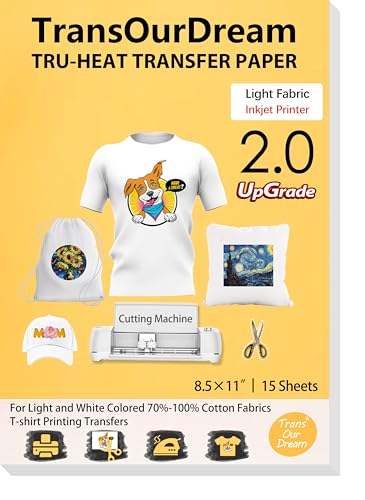
TransOurDream Upgraded Iron-On Transfer Paper is marketed as a light transfer solution, with a pack that includes 15 sheets plus reusable Teflon paper. It’s designed for inkjet printers and works best on light fabrics with 70% to 100% cotton content. The kit promotes a lower melting point for easier iron-on and notes that mirror printing is not required. It’s well-suited for simple text and image transfers onto T-shirts, bags, and other light fabrics, offering straightforward project execution for beginners and hobbyists.
Buying Guide: Key Considerations For Choosing Iron-On Embroidery Transfer Paper
- Fabric compatibility: Consider cotton-dominant fabrics for best results with light-transfer papers, and verify weight tolerance for stabilized fabrics when using sticky stabilizers.
- Printability vs. transfer method: Decide whether you want a printable transfer (inkjet-ready) or a self-adhesive stabilizer that you can draw or print on manually, then apply to fabric.
- Adhesion and stability: Self-adhesive backing helps prevent fabric shifting during embroidery, which is crucial for intricate patterns or dense stitch work.
- Solubility and residue: Water-soluble papers simplify cleanup but ensure complete dissolution to avoid leaving any residue that could affect stitches or fabric feel.
- Ease of use: Look for kits with clear instructions and available tutorials to help with pattern transfer, ironing, stitching, and washing steps.
- Pack size and coverage: Larger sheet sizes (8.5″ x 11″) and multi-pack options can be more cost-effective for frequent projects or larger designs.
- Durability of transfers: For machine embroidery, choose papers with stable adhesion and minimal wrinkling to maintain pattern integrity during needlework.
- Washability: Ensure the transfer is designed to wash away cleanly without leaving marks or residue that could affect fabric texture or stitch quality.
- Ink compatibility: If using printable papers, verify that printer inks (pigment or dye) work with the intended transfer paper, and avoid sublimation inks unless specified.
When selecting an iron-on embroidery transfer paper, weigh the importance of ease of use, cleanup, and pattern fidelity. For beginners, a printable, dissolvable option paired with instructional resources can reduce trial-and-error time. For more experienced crafters, self-adhesive stabilizers that prevent fabric shift during complex stitches may offer better outcomes. Consider the project type, fabric content, and whether you plan to wash the finished item to ensure you choose the best match for your needs.