Creating accurate, lifelike skin tones is a cornerstone of compelling portraiture and character design. The right skin tone markers can simplify blending, shading, and layering, helping artists achieve natural-looking color transitions. This guide highlights five top options for skin tone markers and paints, covering a range of tip styles, surfaces, and finish qualities. Use these picks to expand your palette and enhance your illustrations with diverse, true-to-life skin tones.
Quick reference table of chosen products:
- Sharpie Permanent Markers, Special Edition Portrait Colors
- SFAIH 24 Skin Tone Permanent Markers
- ARTISTRO 24 Skin Tone Acrylic Paint Markers
- Arhomet 6 Colors Skin Tone Alcohol Markers Set
- YOOHO Skin Tone Acrylic Paint Pens
Sharpie Special Edition Portrait Colors Markers

Sharpie’s Portrait Colors lineup offers permanent markers designed to reflect a wide range of global skin tones. The fine point aids precise lines, while the ink adheres to paper, plastic, metal, and many other surfaces. Ideal for portrait studies, fashion sketches, and mixed-media pieces, these markers help achieve consistent, durable color in diverse tones. The set emphasizes permanence, reducing smudging during detailed work and layering across textures.
SFAIH 24 Skin Tone Permanent Markers
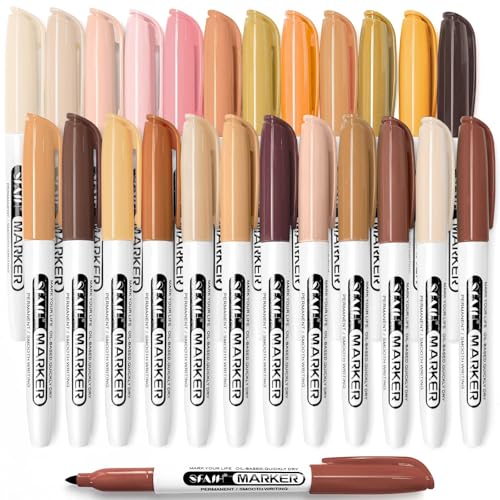
The SFAIH collection provides 24 globally diverse skin tones, enabling smooth transitions and natural rendering in portraits, illustrations, and character design. The markers are described as alcohol-based, with permanent ink that delivers quick-drying results on paper, plastic, wood, and fabric. This versatility supports both professional artwork and everyday crafting, making it a solid choice for detailed complexion work and shading.
ARTISTRO 24 Skin Tone Acrylic Paint Markers

ARTISTRO’s acrylic paint markers blend brush and fine tips, offering versatility for calligraphy, sketching, and coloring. The 1-5 mm brush tip and 1 mm fine tip enable broad strokes and precise details, suitable for canvas, wood, glass, fabric, and more. The water-based, opaque acrylic ink dries quickly with good coverage, reducing the need for multiple layers. These markers are well-suited for portraits and fashion illustrations that require smooth skin-tone work and textured blends.
Arhomet 6 Colors Skin Tone Alcohol Markers Set

Arhomet’s six-color skin tone set emphasizes dual tips: a 6 mm broad chisel for fast coverage and a 1 mm pointed bullet for detailing, highlights, and shading. The markers are described as quick-drying with blendable formulas, and they’re marketed as safe and beginner-friendly. This setup supports rapid base layering and refined accents, making it a practical entry point for artists exploring skin tones in portraits or character art.
Sharxart Brown Skin Tone Alcohol Markers

Sharxart offers six markers with dual tips: a 1 mm fine tip for detail and a 6 mm broad tip for shading and coverage. A gradient palette of nine coordinated colors supports smooth transitions, facilitating depth and realism in skin tones. The ink is alcohol-based, providing fast drying, vibrant color with minimal streaking, which is advantageous for layered portraits and illustrations that demand precise color control.
SFAIH Skin Tone Alcohol Markers Brush & Chisel

This SFAIH set focuses on light skin tones with a brush and chisel tip combination, designed to capture delicate complexions and subtle blushes. It’s positioned as an entry point for realistic portraits and anime-inspired characters, offering a foundation of light shades for soft shading and contouring. The brush tip supports expressive, painterly strokes, while the chisel tip handles broader areas efficiently.
Buying Guide: Key Purchase Considerations
- Marker type and surface compatibility: Decide between alcohol-based markers for blending and permanence, or acrylic paint markers for opaque coverage on wood, glass, and fabric. Some sets include brush tips for soft blends, while others emphasize fine tips for detail work.
- Number of skin tones: Sets with 12–24 tones provide smoother transitions across light to deep complexions. More tones reduce the need to mix colors aggressively and help achieve natural shading.
- Tip versatility: Dual-tip designs (fine + broad or brush + fine) support both detailed facial features and larger area shading. Consider whether you prioritize quick base layers or refined highlights.
- Drying time and bleed control: Quick-drying inks minimize smudging during layering. Look for markers with low bleed on paper, plus fast-drying formulas suitable for overlays and textures.
- Safety and comfort: Non-toxic inks and comfortable pen grips help during extended sessions. If working with children or students, ensure compliance with safety standards and clear usage guidelines.
- Surface range and durability: Acrylic paint markers offer opacity and on-structure versatility (wood, fabric, glass). Alcohol markers excel on paper and certain plastics but may bleed on porous surfaces.
- Blending and color accuracy: Some sets emphasize true-to-life skin tones across a wide spectrum; others focus on a curated gradient for quick shading. Consider your target style—photorealistic vs. stylized.
Additional Notes On Use and Application
When working with skin tones, test swatches on similar paper or surfaces to observe how colors blend and dry. Layer in light, mid, and shadow tones gradually to avoid abrupt changes. For acrylic markers, allow sufficient drying time between layers to prevent mudding, especially when layering multiple color families. For alcohol-based markers, use a compatible blending technique or solvent-friendly paper to exploit smooth gradients without feathering. Always store markers upright and capped to preserve nib integrity and ink freshness.